
Views: 0 Author: Site Editor Publish Time: 2026-05-21 Origin: Site
Core Structures of Piezoelectric Vibration Sensors—Differences Between Compression and Shear Types
Abstract: Structural Types of Piezoelectric Vibration Sensors
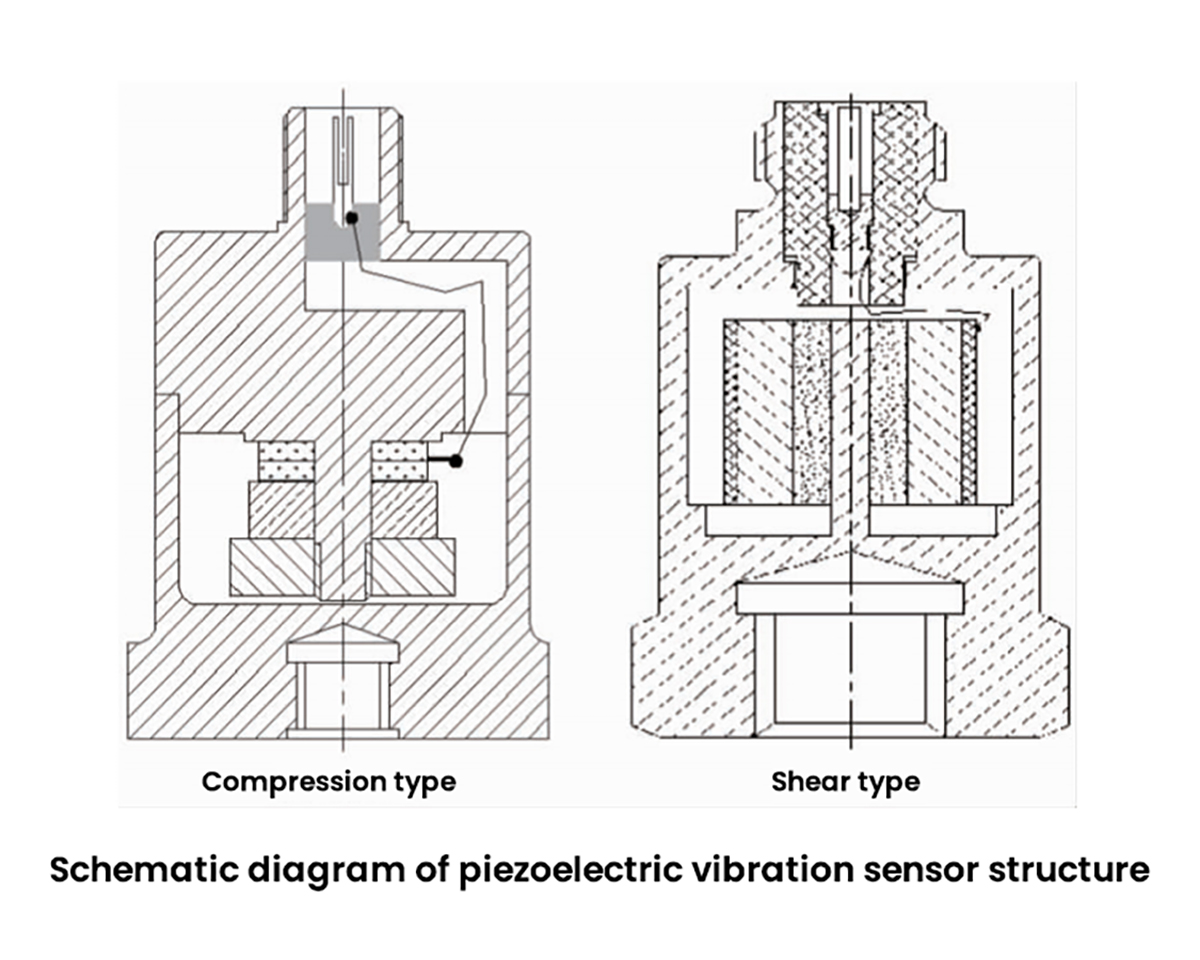
Piezoelectric vibration sensors typically come in two configurations: compression-type and shear-type. In a compression-type sensor, an external force acts perpendicular to the surface of the piezoelectric sensing element, generating an electric charge on that surface. In a shear-type sensor, an external force acts parallel to the surface of the piezoelectric sensing element, generating an electric charge on that surface.
Compression-type structures typically consist of a preload mechanism, a mass block, a piezoelectric sensor, and a housing. The sensor is preloaded by applying a preload force to the sensor body; the magnitude of the preload force applied by the preload nut determines the degree of preload on both the piezoelectric sensor and the mass block.
Shear-type structures typically include: triangular shear, planar shear, and annular shear. They consist of a preload component, a mass block, a piezoelectric sensing element, a base, and a housing. The mass block and the piezoelectric sensing element are clamped to the base via the preload component; the interference fit between the preload component and the mass block determines the degree of preload applied to the piezoelectric sensing element and the mass block.
A. Center-compression type

Design Principles:
The piezoelectric ceramic plate and mass block are stacked vertically on the base like a “sandwich” and held in place by a preload. When vibrated, the inertial force of the mass block compresses the ceramic plate axially (along the central axis), generating an electric charge.
Imagine a vertically mounted spring scale (piezoelectric ceramic) with a weight (mass block) resting on it, the entire system secured to a base. When the base vibrates up and down, the weight’s inertia causes it to try to “lag behind” or “get ahead of” the base, thereby periodically compressing or releasing the spring. The spring’s deformation (in this case, an electric charge) is then used to measure the vibration.
A breakdown of a typical center-compression core:
1. Base: The mounting base for the sensor, typically made of a highly rigid material, which transmits vibrations from the housing to the sensor.
2. Piezoelectric elements: Typically two or more circular piezoelectric ceramic discs (such as PZT). They are stacked with either the same or opposite polarities facing each other (depending on whether the circuit is connected in parallel or series) to amplify the output signal.
3. Mass Block: A high-density heavy metal block (such as tungsten alloy) that provides the required inertial force. The larger the mass block, the higher the sensitivity, but the lower the resonant frequency.
4. Preload Screw: This is the “heart” of the entire structure. A high-strength insulated screw passes through the center holes of the mass block and the piezoelectric ceramic, applying a substantial preload force to firmly clamp the entire assembly (base-ceramic-mass block) together.
5. Insulators: Ensure electrical isolation between the piezoelectric element electrodes and the metal components.
Why is “preload” necessary?
This is key to understanding its performance. Preload serves three critical functions:
Ensuring contact: It prevents the mass block from detaching from the ceramic plate during intense vibration or shock. If detachment occurs, a massive, distorted charge spike is generated upon re-contact, causing severe distortion in the output signal.
Linearization: It ensures the piezoelectric ceramic always operates within the linear range of the preload stress. Even when subjected to tensile inertial forces (upward acceleration), the ceramic plate remains under compression due to the preload, albeit with reduced pressure, thereby ensuring good linearity.
Increased stiffness: The preload enhances the stiffness of the entire stack, thereby raising the resonant frequency of the component.
In-Depth Analysis of Advantages and Disadvantages
Advantages:
Robust construction, simple manufacturing process, and relatively low production costs.
High resonance frequency and wide dynamic range, making it suitable for measuring high-frequency, high-impact vibrations (such as engine knocking and shock testing).
Disadvantages: Highly sensitive to transverse vibrations (vibrations perpendicular to the axis) and temperature changes. Any lateral movement or thermal expansion and contraction will induce additional stress on the ceramic element, resulting in output noise signals—that is, significant “lateral sensitivity” and “pyroelectric effect.”
Illustrative analogy: It is like a “spring scale” placed vertically, which primarily senses upward and downward pressure, but lateral pushing or pulling, or thermal expansion and contraction, can also cause it to produce erroneous readings.
B. Triangular shear type

Design Principle:
Typically, three piezoelectric ceramic elements are arranged in an equilateral triangle pattern and mounted symmetrically around a central mass. Each ceramic element operates in shear mode, and the three are electrically connected in parallel.
Breakdown of a Typical Triangular Shear Element:
1. Core Configuration: Equilateral Triangle Arrangement
Three identical piezoelectric ceramic discs are arranged in an equilateral triangle formation, symmetrically surrounding and adhering to a central mass column. The polarization direction of each ceramic disc is parallel to the direction of vibration. A ring-shaped mass block or a triangular outer ring “envelops” the three ceramic discs and presses them firmly against the central column.
2. Preloading and Assembly Methods
Typically, an external preload ring is used to apply a uniform, centripetal preload force, securing the entire assembly (housing–mass block–triple ceramic–center post) into a single unit. The center mass post is rigidly connected to the housing/base.
3. Operating Principle:
Axial Vibration Response: When axial (Z-axis) vibration occurs, the inertial force of the mass block acts on the contact surfaces of the three ceramic plates, simultaneously and equally exciting shear forces in all three planes. The three ceramic plates are electrically connected in parallel. Because they are subjected to the same forces and have consistent performance, the charges they generate add up in phase, resulting in a total output sensitivity nearly three times that of a single plate and a high signal-to-noise ratio.
Mechanism of lateral vibration immunity: When a lateral vibration from any horizontal direction acts on the sensor, this inertial force is decomposed into a set of asymmetric forces acting on the three ceramic plates.
An In-Depth Analysis of the Pros and Cons
Advantages:
Excellent shock resistance, low transverse sensitivity, and low temperature drift.
Exceptional symmetry; transverse interference from any radial direction is effectively balanced and canceled out, resulting in highly stable overall performance.
High output sensitivity (three elements in parallel) and excellent signal-to-noise ratio.
Disadvantages:
Complex structure with numerous components; it represents the pinnacle of design and manufacturing expertise and is typically used in the most high-end, precision measurement applications (such as aerospace and laboratory reference sensors).
Metaphor: It is like a “three-legged stool,” where three legs (three ceramic plates) evenly support the seat (the mass block). No matter which direction a lateral force comes from, the three legs work together to distribute and cancel it out, ensuring that the seat only senses vertical movement—resulting in unparalleled stability.
C.Flat shear type

Principle of Operation:
Two piezoelectric ceramic plates are mounted side by side on a central shaft, with a mass block “clamped” on either side of the plates. When the system vibrates, the inertial force of the mass block causes the ceramic plates to undergo in-plane shear deformation, thereby generating an electric charge.
A breakdown of a typical planar shear core:
1. Core Components:
Center Post: A cylindrical post protruding from the center of the base, serving as the “framework.”
Piezoelectric Ceramic Plates: Two rectangular or fan-shaped piezoelectric ceramic plates, with their polarization directions perpendicular to the mounting plane; the polarization directions of the two plates are opposite.
Annular Mass Block: A ring-shaped heavy metal block with a hole in the center.
Preload Sleeve/Housing: Used to apply and maintain the preload.
2. Assembly and Force Logic:
Two piezoelectric ceramic discs are symmetrically mounted on either side of the central shaft. The annular mass block is fitted around the outer edges of the two ceramic discs, like a “ring.” Finally, a radial preload is applied through a housing to firmly “clamp” the mass block, ceramic discs, and central shaft together, forming a rigid assembly.
Principle of Operation:
When the sensor is subjected to axial (Z-axis) vibration, the annular mass block tends to remain stationary or lag due to inertia. This inertial force is converted into a shear force acting within the plane of the ceramic plate through the contact surface between the mass block and the ceramic plate. Imagine two ceramic plates as two playing cards pressed tightly together. When one card is fixed (the central pillar) and the other (via the mass block) is subjected to a force parallel to the card’s surface, a slight parallel displacement occurs between the two cards. This “displacement” is shear deformation.
An In-Depth Analysis of the Pros and Cons
Advantages:
Multiple piezoelectric ceramic discs can be connected in series. It is suitable for high-sensitivity applications and offers excellent noise immunity, with strong strain-bearing capacity in the base. Since axial vibration generates shear output, the effects of lateral vibration on the two ceramic discs cancel each other out.
They produce virtually no pyroelectric output. Thermal expansion caused by temperature changes is in the same direction and does not generate a shear effect, resulting in minimal temperature drift.
Disadvantages:
The structure is relatively complex, and installation requires high precision.
High-frequency response is typically slightly lower than that of compression-type sensors of the same size.
Analogy: Imagine rubbing two tiles stuck together with the palms of your hands parallel to each other. Only friction in the forward-backward direction (corresponding to axial vibration) can generate a signal, while pressure from above or below, or from side to side (corresponding to lateral and thermal changes), has little effect.
D.Ring shear

Design Principle:
This is a more sophisticated design. It consists of a ring-shaped (or cylindrical) piezoelectric ceramic with radial polarization; the outer cylindrical surface is plated with electrodes, and a mass column is inserted through the central hole. When vibrating, the inertial force of the mass column subjects the inner wall of the ceramic ring to a circumferential shear force.
Disassembling a typical annular shear core:
1. Radially Polarized Piezoelectric Ceramic Ring
A thin-walled cylindrical piezoelectric ceramic that has been precision-sintered, polished, and high-voltage polarized. It is polarized radially (similar to the spokes of a wheel, extending from the center to the outer edge or vice versa). This is the physical basis for all of its excellent properties.
2. Center of Inertia Mass Column
A cylinder made of high-density material (such as tungsten alloy). It is pressed into the inner bore of a ceramic ring with extremely high fitting precision and an interference fit. The enormous, uniform radial preload generated by this process ensures structural rigidity and linearity.
3. Base and Housing
The outer cylindrical surface of the ceramic ring is secured to the surrounding metal base using conductive adhesive or metal-to-metal welding. The base is connected to the sensor housing, transmitting external vibrations to the entire system.
Principle of Operation:
During axial vibration: The ceramic ring mounted on the base moves with the housing, while the central mass column lags behind due to inertia. The relative displacement between the two, combined with the strong frictional coupling created by the preload, is converted into circumferential shear strain on the inner wall of the ceramic ring.
Charge Generation: This circumferential shear strain excites the shear modulus of the piezoelectric ceramic. Since the polarization direction is radial, the shear occurs in a plane perpendicular to the polarization, thereby efficiently generating a charge proportional to the axial acceleration. The charge is typically tapped from the inner electrode of the ceramic ring (connected to the mass column), while the outer electrode is grounded to provide shielding.
An In-Depth Analysis of the Pros and Cons
Advantages:
Low lateral sensitivity and minimal temperature drift.
The structure is more compact, symmetrical, and highly rigid, resulting in a very smooth and wide frequency response curve with low background noise.
It is ideal for use in miniaturized, high-performance accelerometers.
Disadvantages:
It requires the highest precision in machining and assembly, and is also costly.
Metaphor: It is like a “sleeve” fitted over a column. When the column vibrates vertically, the inner wall of the sleeve experiences circumferential friction (shear force), but since the sleeve itself expands and contracts uniformly (due to temperature changes), no shear force is generated.
In summary, the core structure—the “heart” of a piezoelectric vibration sensor—primarily revolves around two fundamental mechanical modes: compression and shear.
The center-compression type, like a no-nonsense tough guy, holds its ground in the field of high-frequency impulse measurement thanks to its simple structure and extremely high frequency response.
The shear-type family (planar, annular, and triangular shear), on the other hand, is more like a meticulous craftsman. By causing the inertial force to “take a detour” to drive the piezoelectric ceramic, they cleverly shield against interference from lateral vibrations and temperature fluctuations, making them the stable and reliable choice for the vast majority of industrial vibration monitoring applications.
From simple “sandwich” compression to sophisticated planar symmetric cutting, and from seamless ring-shaped monolithic designs to highly redundant triangular layouts, this evolutionary journey epitomizes engineers’ relentless pursuit of higher signal-to-noise ratios and purer signals. Choosing a particular structure essentially involves finding the optimal balance between frequency, environmental conditions, precision, and cost.
Yangzhou Xiyuan Electronic Technology Co.,Ltd.
#77 Yeqiao Road, Liandong U Valley slender West Lake Innovation port, building 10-2,Hanjiang District, Yangzhou,Jiangsu,China
Mobie Phone: +86 180-5105-8377
Tel: +86 514-82885589
Whatsapp:+86 182-6066-6867
Email: sale1@yzxyt.com
Fax: +86 514-82885089


